Imagine walking into your living room to find shattered glass and standing water while the Mesa heat is already climbing toward triple digits. You know that moisture combined with Arizona’s 2025 record temperatures, the fifth hottest monsoon on record, creates a breeding ground for mold in less than 24 hours. Finding reliable monsoon storm damage repair Mesa residents can trust is no longer just a goal; it’s a high-stakes race against time. You’re likely feeling the weight of the chaos and the fear of hiring “storm chasers” who do more harm than good.
We understand that your home is your sanctuary, and seeing it in disarray is deeply unsettling. This guide provides the exact steps you need to secure your property, navigate the complexities of Mesa’s 2024 building codes, and manage your insurance claim without the administrative friction. You’ll learn how to move from initial impact to a fully restored, pre-loss condition by following a professional recovery roadmap. We’ll cover everything from immediate mitigation to the final reconstruction details to ensure your peace of mind is restored along with your roof.
Key Takeaways
- Act fast to stabilize your property and understand why a rapid arrival time is the critical factor in preventing permanent structural loss.
- Identify hidden threats by performing a professional perimeter check for stucco displacement and internal signs of moisture like musty odors.
- Master the professional drying protocol used in monsoon storm damage repair Mesa to ensure all moisture is removed before mold takes hold.
- Simplify your recovery through direct insurance coordination and a checklist of the essential documentation your adjuster needs for claim approval.
- Transition seamlessly from emergency mitigation to professional reconstruction services that return your home to its pre-loss condition.
Emergency Monsoon Storm Damage Response in Mesa
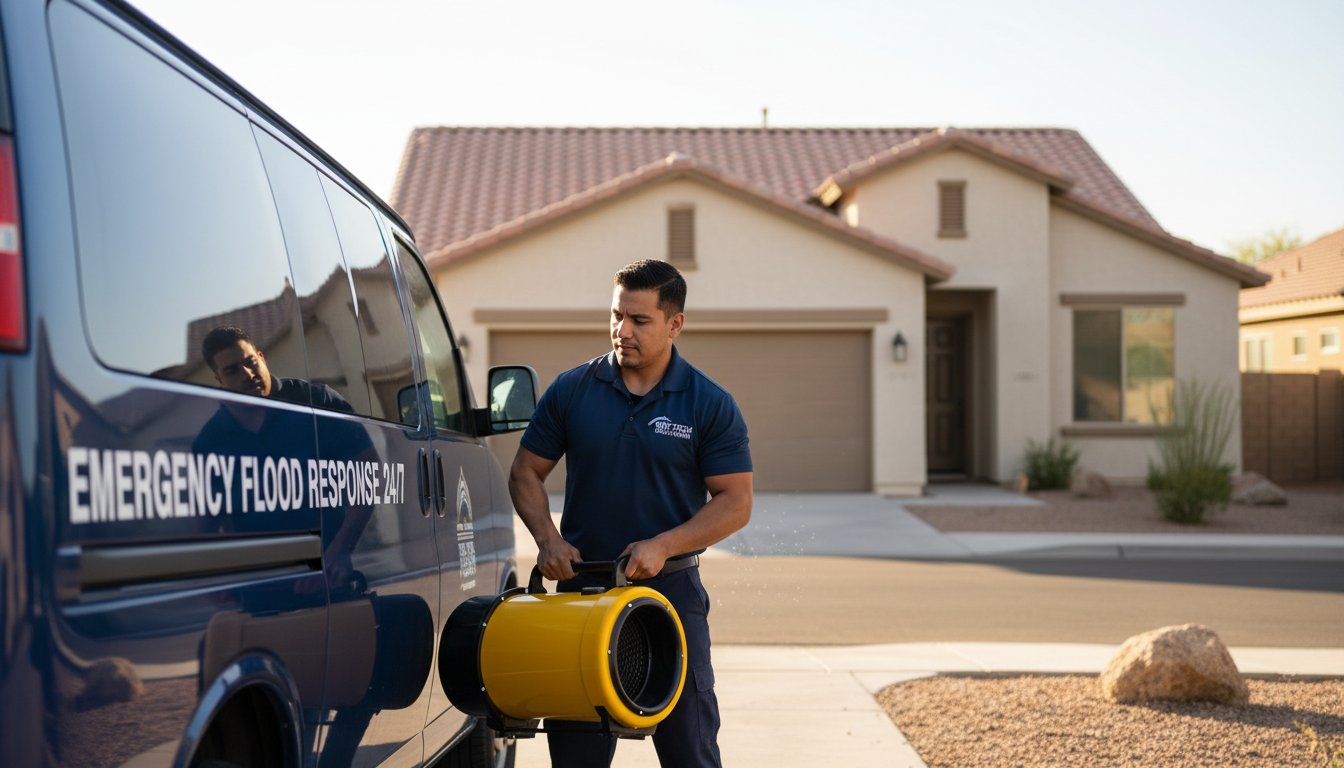
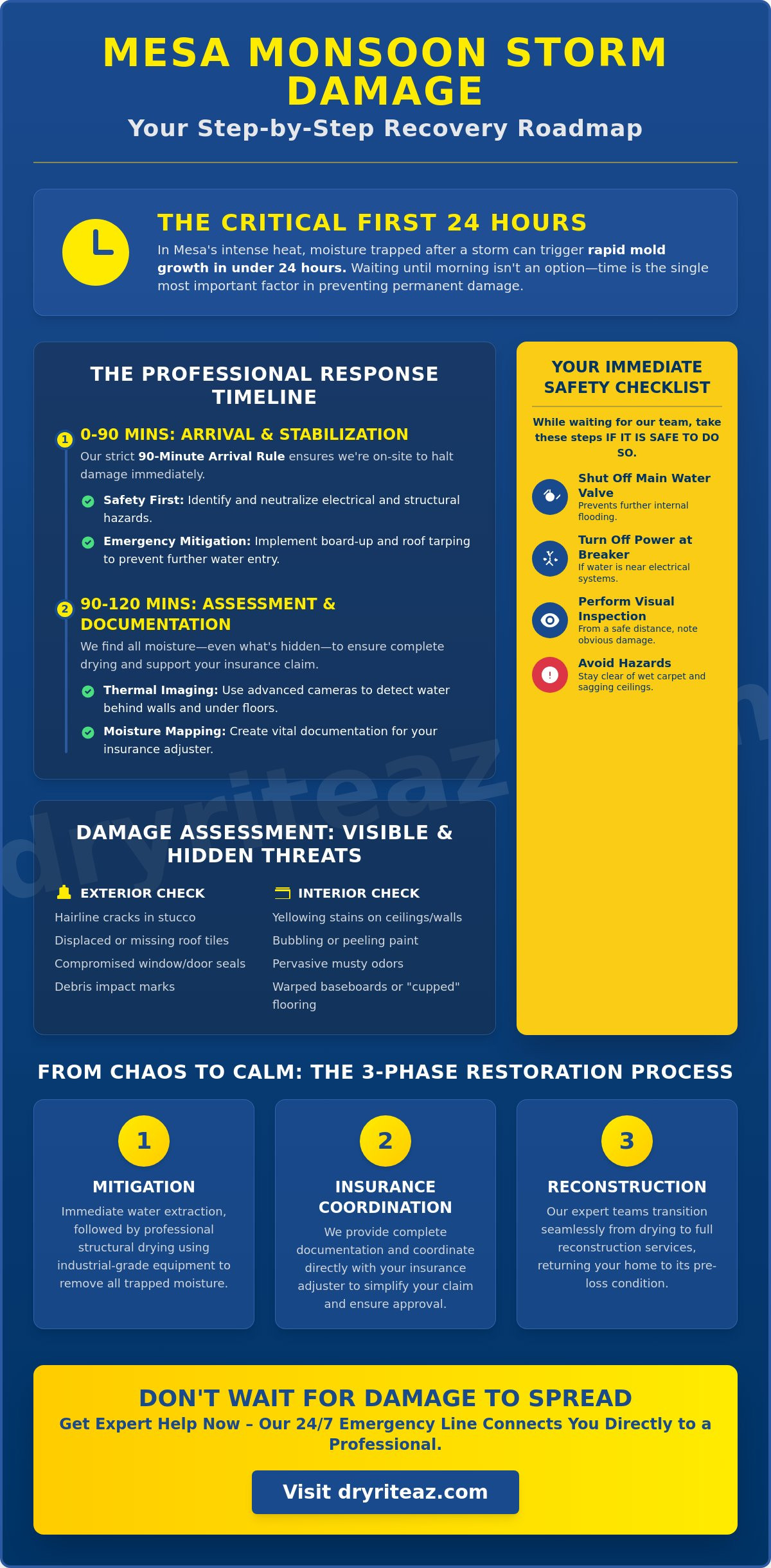
Professional monsoon restoration isn’t just about cleaning up debris. It’s about the immediate stabilization of your property after the high winds and torrential rains of the North American Monsoon. When a storm hits, your home’s envelope is often breached by wind, hail, or flooding. This creates a state of emergency where every minute counts. We operate on a strict 90-minute arrival rule because time is the single most important factor in Mesa. In our desert climate, moisture trapped inside a wall can trigger rapid mold growth in under 24 hours. Waiting until the next morning isn’t an option.
Safety is our first priority upon arrival. Before entering any damaged structure, we identify electrical hazards and structural compromises that could put you or our team at risk. If you see downed power lines or sagging ceilings, stay clear. Our 24/7 emergency line is staffed by experts who understand the high-stakes nature of monsoon damage. We don’t use call centers; we provide direct contact to professionals who can initiate the monsoon storm damage repair Mesa homeowners need to stop further degradation.
Immediate Steps to Secure Your Property
While waiting for the response team, focus on safety and containment. Don’t take unnecessary risks, but if it’s safe to do so, follow these steps to protect your home:
- Shut off the main water valve if you notice internal flooding to prevent additional pressure on your plumbing.
- Turn off the power at the breaker box if you suspect water has entered the electrical system or ceiling fixtures.
- Perform a visual inspection from a distance. Look for roof breaches, broken windows, or displaced stucco.
- Avoid walking on wet carpets or under sagging drywall. These materials are heavy and can collapse without warning.
What to Expect in the First 2 Hours
The first 120 minutes are dedicated to halting the chaos and stabilizing the environment. Once the Dryrite emergency team arrives, we move through a disciplined assessment protocol. We use thermal imaging and moisture mapping to find water hidden behind walls and under flooring. This documentation is vital for your insurance claim and ensures no pocket of moisture is left behind. Next, we implement emergency board-up and roof tarping services. This stops secondary rain damage from subsequent storm cells, which are common during the peak season. By securing the perimeter and beginning the extraction process immediately, we shift your home from a state of turmoil back toward tranquility. Our goal is to protect your investment and your family’s health through decisive, expert action.
How to Assess Your Property After a Mesa Storm
Once the winds die down, the real work begins. Assessing your property is a race against Mesa’s intense heat, which accelerates mold growth in damp materials. Start with a methodical perimeter walk-around. Look for hairline cracks in your stucco or displaced roof tiles. Even minor gaps allow driving rain to penetrate your home’s structural layers. If you find debris impact or shingle loss, document the area immediately. High-velocity gusts frequently compromise the seals around windows and doors, so check these transition points for moisture or grit.
Move your inspection indoors next. Examine every ceiling and wall for yellowing stains or bubbling paint. These are clear indicators of water intrusion. Don’t ignore musty odors; they often signal moisture trapped in insulation or wall cavities. Check your attic and crawl spaces specifically. Mesa monsoons often drive water into these unexpected voids through soffit vents or small roof breaches. Capture high-quality photos and video of every finding before you touch anything. This evidence is the backbone of your insurance claim and provides the documentation needed for professional monsoon storm damage repair Mesa experts to advocate for your coverage.
Identifying Hidden Water Damage
Visible signs only tell half the story. Professional thermal imaging leak detection allows us to see temperature differentials that indicate moisture behind drywall without cutting unnecessary holes. Check your baseboards and flooring for subtle warping or “cupping.” If a wood floor feels slightly uneven, water has likely reached the subfloor. A surface might feel “dry to the touch,” but that doesn’t mean your subfloor is safe. Saturated subflooring leads to structural rot and long-term mold issues if not addressed quickly.
Storm Damage Categories in Arizona
Understanding the type of damage helps prioritize your recovery and ensures you follow the right safety protocols. Common issues include:
- Wind Damage: High-velocity gusts cause shingle loss, fence failure, and debris impact.
- Flood Damage: Flash flooding can send street runoff into your home. Always follow official Flood Safety Guidelines to avoid contaminated water hazards.
- Hail Damage: While less frequent, hail compromises roof integrity and stucco finishes. These micro-fractures often go unnoticed until the next heavy rain, leading to slow leaks and hidden mold.
By identifying these issues early, you prevent secondary damage and ensure a smoother restoration process. Decisive action now prevents a manageable repair from turning into a total loss later.
The Professional Restoration and Structural Drying Process
Extraction is your home’s first line of defense. We use heavy-duty, truck-mounted vacuum systems to pull standing water from your living spaces immediately. This step is critical because it removes the bulk of the moisture before it can seep deeper into your subfloors or structural studs. Once the standing water is gone, we move into a scientific drying protocol. This isn’t a matter of just pointing fans at a wet wall. It involves a calculated balance of high-volume airflow, controlled temperature, and industrial dehumidification. We follow Arizona’s official guide to disaster recovery standards to ensure your property is restored safely and in compliance with local regulations.
Effective monsoon storm damage repair Mesa requires a deep understanding of how desert humidity interacts with structural materials. During a storm, the outdoor humidity spikes, and when that moisture enters a 100-degree home, it creates a greenhouse effect. We apply professional anti-microbial treatments to all affected surfaces early in the process. This stops mold spores from colonizing while the materials are still damp. We don’t guess when the job is done. Our team performs daily monitoring, using moisture probes and sensors to track the progress of every saturated material until it reaches its pre-determined “dry standard.”
High-Efficiency Structural Drying
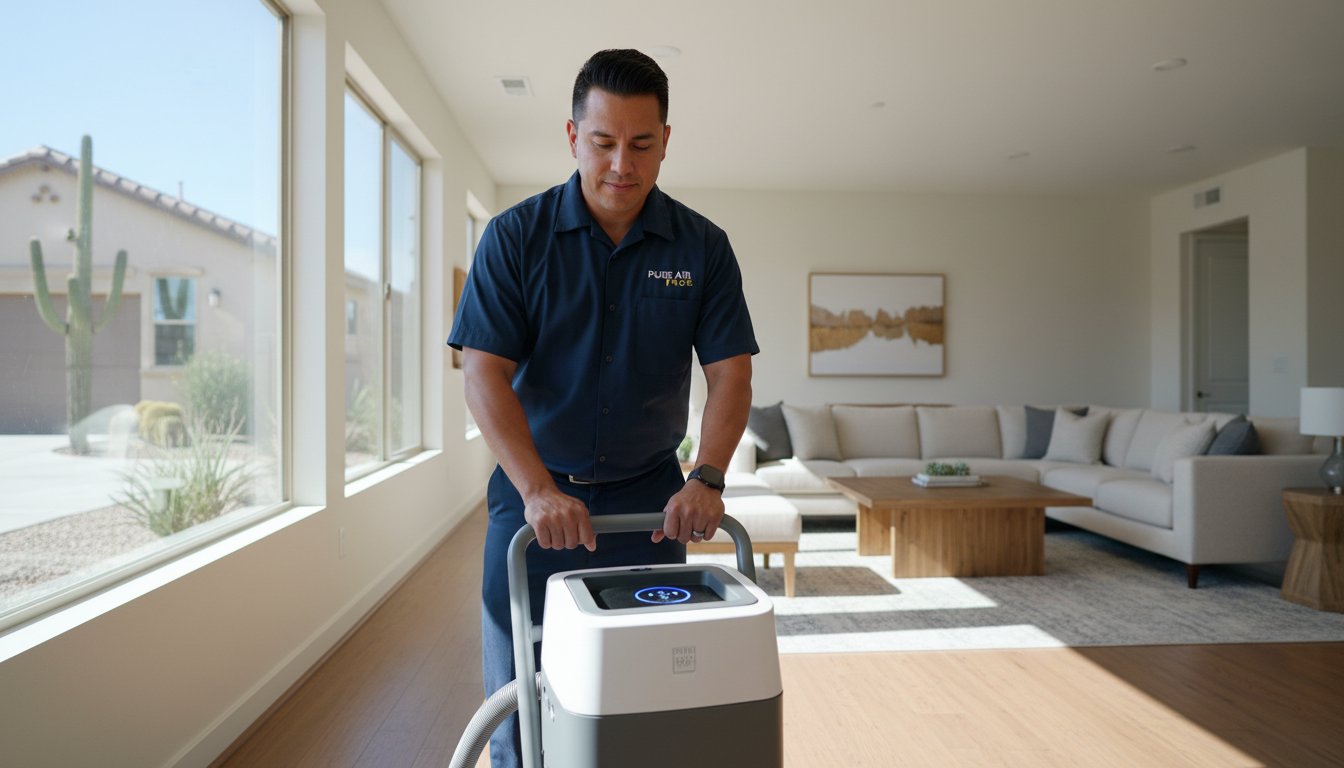
Mesa’s climate demands specialized equipment. We utilize industrial Low Grain Refrigerant (LGR) dehumidifiers that are specifically designed to pull moisture out of the air even in high-heat, high-humidity environments. We place high-velocity air movers to create a “vortex” drying pattern. This constant movement of dry air across wet surfaces accelerates evaporation at the molecular level. Because moisture can migrate unexpectedly, water damage restoration mesa az professionals provide 24/7 monitoring of the equipment to ensure the environment remains optimized for drying. This prevents the “re-wetting” of materials that can happen if dehumidifiers reach capacity.
Mold Prevention in 100-Degree Heat
The 24 to 48 hour window is your only chance to prevent a total mold infestation. In Mesa, heat acts as a biological catalyst. When water is trapped behind a baseboard in 100-degree weather, mold can begin to grow in half the time it takes in cooler climates. We use HEPA filtration and industrial air scrubbers to maintain your indoor air quality. These machines pull microscopic spores and dust out of the air, ensuring your family breathes clean air during the restoration. We also establish physical containment zones. By sealing off the damaged area with heavy-duty plastic, we ensure that spores and debris don’t migrate into the unaffected parts of your home. This disciplined approach brings order to the chaos of a storm.
Navigating Monsoon Insurance Claims in Mesa
Managing the aftermath of a storm is emotionally draining. The last thing you need is a battle over paperwork. We simplify the process through direct insurance billing. This means we work directly with your carrier to manage the financial details, allowing you to focus on your family’s recovery. For a successful monsoon storm damage repair Mesa claim, documentation is your most powerful tool. Your adjuster needs a clear timeline and visual proof of the initial impact. We provide the comprehensive moisture maps and damage logs required by major Arizona insurance providers to justify every repair.
It’s vital to distinguish between “storm damage” and “flood damage” under Arizona law. Standard homeowner policies usually cover wind-blown rain that enters through a roof breach or broken window. However, rising water from the street or a nearby wash often requires a separate flood insurance policy. If we discover “hidden damage” like saturated insulation or mold mid-restoration, we handle the supplement process for you. This involves submitting additional evidence to your adjuster so the extra repairs are covered without coming out of your pocket. We ensure no detail is missed during the transition from chaos to peace.
Working with Your Insurance Adjuster
Don’t meet the adjuster alone. Schedule the adjuster meeting when your restoration contractor can be present. We speak the technical language of insurance and can point out subtle structural issues they might overlook during a quick walkthrough. We review the scope of work together to ensure every necessary repair is included in the initial estimate. Accuracy is critical when managing the “Proof of Loss” statement. A single error can delay your funding for weeks. We ensure the documentation is precise from day one to keep your project moving forward.
Maximizing Your Coverage
Understand your policy type before the work begins. Most Arizona residents have Replacement Cost Value (RCV) coverage, which pays to replace damaged items with new materials. Some older policies use Actual Cash Value (ACV), which factors in depreciation and leaves you with higher out-of-pocket costs. A professional estimate from Dryrite carries significantly more weight than a DIY assessment because it’s based on industry-standard Xactimate pricing. Keep a communication log of every call and email with your insurance company to avoid gaps in your claim history. If the paperwork feels overwhelming, contact our insurance coordination team to start your recovery today.
Reconstruction: Returning Your Mesa Home to Peace
Mitigation stops the immediate threat, but reconstruction is what truly restores your sanctuary. Once our team certifies that your structure has reached professional dry standards, we shift from defense to offense. This transition is the final phase of monsoon storm damage repair Mesa, where we move beyond stabilization and begin the physical rebuilding of your living space. We handle everything from the installation of new moisture-resistant drywall to the precise application of paint and the laying of new flooring. If your property suffered from fallen trees or debris impact during the storm, our team manages complex structural repairs, including the restoration of roof trusses and framing to ensure your home meets the 2024 International Code Council (ICC) standards adopted by the City of Mesa.
We understand that the restoration process is about more than just building materials; it’s about reclaiming your emotional well-being. To provide lasting peace of mind, we stand behind our work with a 2-year guarantee on our mitigation services. This warranty acts as a stabilizing force, ensuring that the work performed during the height of the crisis remains sound for years to come. By managing both the cleanup and the reconstruction internally, we eliminate the communication gaps and scheduling conflicts that often occur when homeowners are forced to juggle multiple subcontractors. We bring order to the chaotic aftermath of a storm through disciplined project management and a commitment to transparent communication.
Seamless Full-Service Restoration
The primary benefit of a full-service restoration partner is the continuity of care. We maintain detailed records from the initial moisture mapping phase, which informs every decision made during the rebuild. This ensures material consistency and perfect color matches, preventing your home from looking “patched together.” A typical monsoon project moves quickly once the drying phase is complete, with a timeline focused on efficiency without sacrificing quality. We manage the procurement of all materials and the coordination of specialized trades internally, ensuring that your property returns to its pre-loss condition as quickly as possible. You won’t have to explain your situation to a new crew every week; our team stays with you from the first emergency call to the final nail.
Future-Proofing Against the Next Monsoon
Recovery provides a unique opportunity to strengthen your home against future weather events. During the reconstruction phase, we can discuss upgrading to impact-resistant materials or improving your property’s drainage systems to mitigate the risk of flash flood intrusion during the next record-breaking season. Our process concludes with a rigorous final walkthrough and a quality assurance check. We examine every seam, joint, and finish to ensure the work meets our high standards of professional competence. We don’t just fix what was broken; we provide the quiet strength and expert handling necessary to turn a disaster into a distant memory. Your home is returned to a state of tranquility, fully prepared for whatever the Arizona sky brings next.
Secure Your Property and Restore Your Tranquility
Recovering from a desert storm requires more than just cleanup; it demands a disciplined, expert approach to protect your home’s future. You now have the roadmap to handle the immediate crisis, from securing the perimeter to navigating complex insurance documentation. Remember that speed is your greatest ally against Mesa’s heat-driven mold. By acting within the first 24 hours and insisting on professional moisture mapping, you prevent a manageable repair from becoming a structural disaster. Choosing the right specialist for monsoon storm damage repair Mesa is the most important decision you’ll make after the clouds clear.
We are the experienced protectors you need in a crisis. Our team provides 24/7 emergency service with a guaranteed 90-minute on-site arrival to stabilize your property instantly. As a licensed, bonded, and insured restoration partner, we manage every detail from mitigation to reconstruction. We even provide a 2-year warranty on our mitigation work to ensure your long-term security. Get a 90-minute emergency response for your Mesa storm damage; call Dryrite now! You’ve navigated the worst of the storm. Now, let us handle the hard work of bringing you back to a state of peace.
Frequently Asked Questions
How long does monsoon storm damage repair usually take in Mesa?
Mitigation typically takes three to five days, while full reconstruction can range from one to three weeks. The total timeline for monsoon storm damage repair Mesa homeowners experience depends on the extent of structural intrusion and material availability. We prioritize rapid drying to shorten the overall recovery window and prevent secondary issues.
Does my standard Arizona homeowners insurance cover monsoon flood damage?
Standard Arizona policies usually exclude damage from rising surface water or flash floods. While they cover wind-driven rain entering through a roof breach, water that enters from the ground up requires a separate flood insurance policy. You should check your declarations page specifically for “surface water” exclusions to understand your coverage limits.
Can I stay in my home during the storm restoration process?
You can often stay in your home if the damage is localized to a specific area. However, we recommend temporary relocation if there are structural compromises, sewage backups, or if the power must be shut off for safety. We evaluate habitability during our initial 90-minute assessment to ensure your family’s well-being.
How quickly does mold start growing after a monsoon storm in Mesa?
Mold begins to colonize within 24 to 48 hours when moisture meets Mesa’s high temperatures. The intense summer heat acts as a biological catalyst, speeding up the growth process significantly compared to cooler climates. This is why immediate water extraction is the most critical step in preventing a total mold infestation.
What should I do if a tree falls on my house during a storm?
Evacuate the area immediately and call for emergency services if the tree has compromised power lines. Once the site is declared safe by authorities, contact us for professional stabilization. We provide emergency board-up and roof tarping to prevent additional rain from entering the structural breach while you wait for the adjuster.
Will Dryrite work directly with my insurance company?
Yes, we coordinate directly with your insurance carrier to manage the billing and documentation process. Our team uses industry-standard estimating software to ensure your adjuster has all the evidence needed for claim approval. We focus on managing the paperwork so you can focus on returning your life to a state of tranquility.
What is the difference between water mitigation and reconstruction?
Water mitigation is the emergency stabilization of your property, including extraction and industrial drying. Reconstruction is the final phase where we rebuild the physical structure to return it to pre-loss condition. This includes replacing drywall, flooring, and paint after the environment is certified as dry and safe.
How do I know if my roof has hail damage after a storm?
Look for circular dimples or “bruises” on your shingles and check your downspouts for an unusual amount of shed granules. You should also inspect metal roof vents, gutters, and window trim for small dents. These subtle signs often indicate compromised integrity that can lead to slow leaks and hidden mold growth over time.