Most homeowners assume that measuring a room is the only step to calculating an asbestos removal cost per square foot, but the reality is far more complex. You’re likely feeling the weight of a renovation that just stalled. Discovering that your Arizona home contains hazardous materials is stressful; it’s natural to worry about your family’s safety and the potential for hidden expenses. You need a home that’s toxin-free without being blindsided by the bill.
Once your home is safe and the stress of restoration is over, it’s the perfect time to celebrate your renewed space; you can learn more about Casino Party Packages to host an exciting, professional event for your friends and family in your newly toxin-free environment.
Get a professional breakdown of how abatement costs are actually calculated in 2026. We’ll help you move from a state of uncertainty to a clear, actionable plan. We’ll explore how containment needs, disposal requirements, and Arizona’s strict regulatory standards in counties like Maricopa and Pima ultimately shape your final estimate. You’ll gain the peace of mind that comes from knowing exactly what drives the numbers and how to ensure the job is done legally and safely.
Key Takeaways
- Understand how 2026 industry standards define the asbestos removal cost per square foot and why initial setup fees create project minimums.
- Identify the “containment factors” and accessibility challenges that often drive local abatement estimates higher than standard averages.
- Navigate Arizona-specific hurdles, including strict Maricopa County NESHAP notifications and the impact of extreme heat on technician schedules.
- Evaluate the cost-effectiveness of encapsulation versus removal to decide which solution provides the best long-term security for your property.
- Protect your family and your budget by learning why professional handling is the only way to avoid invisible health risks and legal fines.
Calculating Asbestos Removal Cost Per Square Foot in 2026
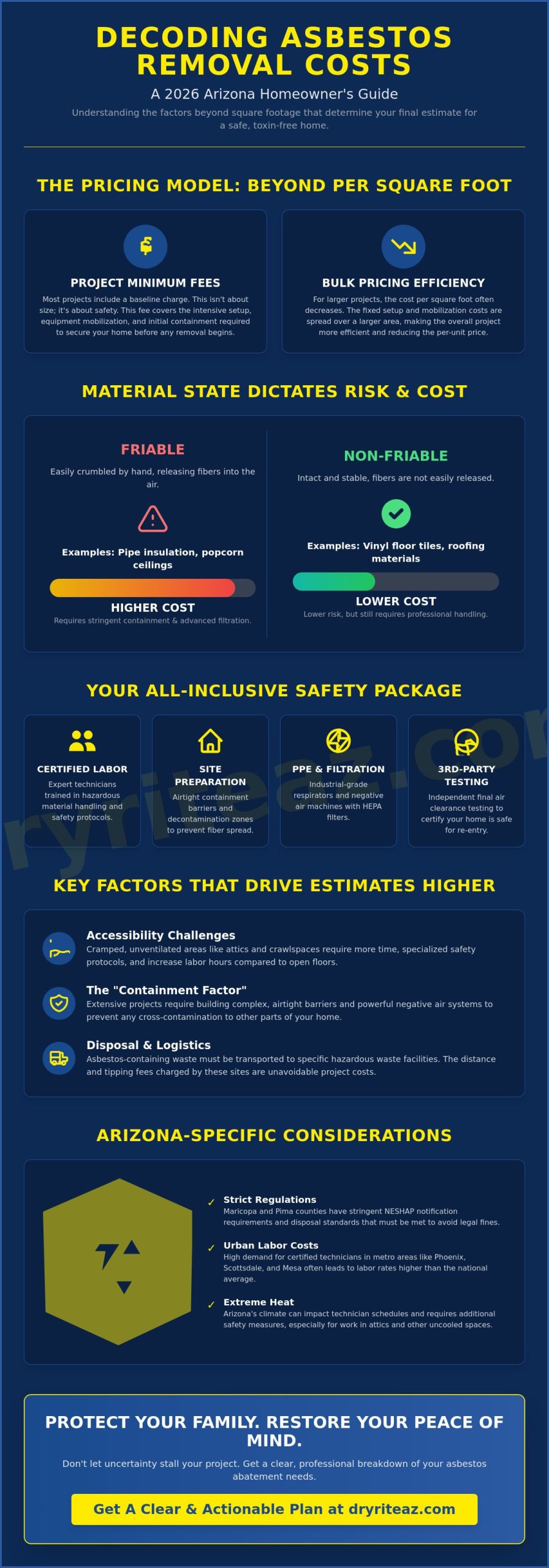
Understanding the financial side of abatement starts with the standard industry pricing model. Professionals typically provide an Asbestos removal cost per square foot to account for the specialized labor and high-grade equipment required. This per-unit rate helps you visualize the budget, but it’s rarely a flat fee across the board. Most projects involve a baseline minimum charge. This covers the intensive labor required to secure your home before a single fiber is disturbed. It’s about safety, not just square footage.
The physical state of the material significantly dictates the rate. Friable materials, which are easily crumbled by hand, pose a much higher risk of fiber release. These require more stringent containment and advanced HEPA filtration, leading to higher per-foot costs compared to non-friable materials like intact floor tiles. For larger projects, you’ll often see “bulk pricing” logic applied. As the total square footage increases, the mobilization and setup costs are spread across a larger area. This can lower the individual price per foot because the team is already on-site with the necessary gear. It’s a matter of operational efficiency during the recovery process.
National Averages vs. Arizona Market Rates
Arizona’s market presents unique variables for homeowners in the Phoenix metropolitan area. Labor costs in cities like Mesa and Scottsdale often trend higher than national rural averages due to the high demand for certified hazardous material technicians. Urban density also plays a role. Mobilization fees in crowded Scottsdale neighborhoods may reflect the logistical complexity of staging large equipment and waste containers in tight spaces. In 2026, disposal rates at Arizona hazardous waste facilities remain a fixed project cost. These facilities charge by weight or volume to accept contaminated waste, and these fees are passed directly into your project estimate to ensure legal compliance.
What is Included in the Per-Foot Price?
A professional estimate is comprehensive. It isn’t just about the physical removal of the material. Your asbestos removal cost per square foot covers several critical layers of protection:
- Certified Labor: Expert technicians trained in high-stakes hazardous material handling.
- Site Preparation: Constructing airtight plastic barriers and installing decontamination showers.
- PPE and Filtration: Industrial-grade respirators and negative air machines equipped with HEPA filters.
- Third-Party Testing: Final air clearance testing by an independent laboratory to prove your home is safe for re-entry.
By managing every detail internally, we eliminate communication gaps and ensure your project stays on track. This organized approach brings order to the chaos of a home renovation crisis. We focus on the restoration of your emotional well-being by handling the technical burden of regulatory compliance and safety protocols.
Factors That Drive Your Asbestos Abatement Estimate Higher
While we’ve established the baseline asbestos removal cost per square foot, the specific layout of your property often dictates the final invoice. It isn’t just about the volume of material. It’s about the labor hours required to reach the toxin and the safety measures needed to isolate it. Complexity is the primary driver of any professional abatement budget. When a project moves from a wide-open floor to a confined space, the logistics shift dramatically.
Crawlspaces and attics are high-stakes environments. Technicians work in cramped, unventilated spaces where heat exhaustion and limited mobility increase the risk level. These areas require more time and specialized safety protocols, naturally increasing the cost compared to accessible flooring. We also factor in the “Containment Factor.” This involves building airtight plastic barriers and decontamination showers to isolate the work zone completely. According to standards enforced by the Occupational Safety and Health Administration, preventing fiber migration is non-negotiable. We maintain negative air pressure using industrial HEPA-filtration units to ensure microscopic fibers don’t drift into your living room or HVAC system.
Logistics and disposal fees also play a significant role in your estimate. Asbestos-containing waste cannot go to a standard neighborhood landfill. It must be transported to specific hazardous waste facilities that accept these materials. The distance to the nearest approved site and the tipping fees charged by those facilities are unavoidable costs. We manage these logistics internally to ensure full regulatory compliance and prevent any legal liability for the homeowner.
Material Type and Location Complexity
Popcorn ceiling removal is labor-intensive due to the height and the delicate nature of the texture. Scraping these surfaces requires meticulous care to prevent massive dust release. Pipe insulation often requires “glove bag” techniques, where technicians seal the pipe in a specialized bag to contain the fibers during the cut. In contrast, removing floor tile and mastic is often the most affordable per-foot removal because the material is usually non-friable and easier to manage.
Post-Removal Reconstruction Needs
Abatement is only the first half of the recovery journey. Once the hazard is gone, you’re often left with bare studs, missing ceiling sections, or stripped subfloors. Budgeting for drywall replacement and painting is essential to return your home to its original state. Dryrite Restoration simplifies this transition by providing expert reconstruction services after water damage or hazardous material removal. Matching existing wall textures and paint colors is a precise process that ensures your home feels whole again. If you’re ready to clear the air and start the rebuilding process, visit dryriteaz.com to see how we bring order back to your property.
Arizona-Specific Considerations for Asbestos Abatement
Arizona homeowners face a unique regulatory and environmental landscape that directly impacts the project timeline and logistics. It isn’t just about the physical asbestos removal cost per square foot; it’s about navigating the strict mandates set by the Arizona Department of Environmental Quality (ADEQ) and local county agencies. In the Valley, compliance is a matter of public safety and legal protection. Ignoring these rules can lead to massive state fines and long-term health liabilities for your family. Dryrite Restoration acts as your seasoned guide through this complex process, ensuring every permit is filed and every regulation is met with precision.
While national reports from outlets like Forbes highlight general pricing trends, Arizona’s specific mandates add layers of administrative necessity. For instance, Maricopa County has additional regulations that go beyond federal NESHAP standards. These rules aren’t suggestions. They are strictly enforced requirements designed to prevent toxic dust from entering our desert air. Hiring a licensed Arizona contractor isn’t just a recommendation; it’s your primary defense against the chaos of failed inspections and legal complications.
Maricopa County Permit and Notification Fees
The Maricopa County Air Quality Department (MCAQD) requires a 10-day notification before any renovation or demolition project that meets specific material thresholds begins. This mandatory waiting period is a non-negotiable part of your project schedule. For full structure demolitions in Maricopa County, the notification fee is currently $600. These fees are structured based on the volume of material being disturbed. Dryrite Restoration handles the paperwork and coordination with the ADEQ to ensure your project doesn’t stall due to administrative gaps. This transparency keeps your budget predictable and your home recovery on track.
Climate Challenges in the Valley of the Sun
Arizona’s extreme climate presents physical hurdles that most national guides ignore. During the summer months, attic temperatures in Phoenix can easily exceed 140 degrees. Technicians working in full-body Tyvek suits and respirators face severe heat stress risks. This requires shorter work shifts and more frequent rotations to ensure safety. To maintain a safe environment, we often deploy specialized cooling equipment and high-powered HEPA-filtration units that can handle the intense heat and low humidity. These scheduling considerations are vital during the monsoon season when sudden humidity spikes can affect how containment barriers and adhesives perform. Dryrite Restoration plans for these variables so your asbestos removal cost per square foot remains a reliable metric, even in the harshest Arizona weather.
Encapsulation vs. Removal: Which Is More Cost-Effective?
Encapsulation is the process of sealing asbestos-containing materials with a specialized liquid coating rather than physically extracting them. This creates a protective barrier that prevents fibers from becoming airborne. While the initial asbestos removal cost per square foot is higher than encapsulation, the latter often carries hidden long-term burdens. You might save money today, but you’re essentially managing a permanent hazard. It’s a temporary shield, not a final solution.
Removal is often the only legal path forward if you’re planning a major demolition or structural renovation. Arizona law requires the extraction of friable materials before they’re disturbed by construction crews. Additionally, leaving asbestos in place can complicate future emergencies. For example, if you experience a pipe burst, having encapsulated asbestos can significantly delay water damage restoration mesa az. Restoration teams can’t safely dry out walls if they contain sealed-in toxins that might be released during the moisture extraction process. This delay can lead to secondary issues like mold growth, driving your total recovery costs even higher.
When Encapsulation Makes Financial Sense
Encapsulation is a viable strategy for intact materials in low-traffic, isolated areas. Basements or crawlspaces with undisturbed insulation are prime candidates. Commercial property managers often choose this route to manage large portfolios under tight budgets. However, this isn’t a “set it and forget it” solution. You must commit to ongoing monitoring and professional inspections to ensure the sealant remains intact. Any peeling or cracking immediately reintroduces the risk of exposure, requiring immediate intervention. We help you weigh these ongoing maintenance costs against the physical asbestos removal cost per square foot to find the most stable path forward.
The Long-Term ROI of Complete Removal
Choosing full extraction offers a superior return on investment for residential property owners. A “clean” environmental report is a powerful asset during home resale. Buyers in the 2026 market are increasingly wary of legacy hazards; removing the material eliminates that friction entirely. It also removes the need for expensive asbestos inspections every time you want to update a bathroom or remodel a kitchen. The most significant benefit is the restoration of your peace of mind. Families with young children or pets benefit from knowing their home is truly toxin-free. You won’t have to worry about a stray ball hitting a ceiling or a minor leak turning into a hazardous materials crisis. If you’re ready to permanently clear the hazard from your home, contact our expert abatement team today.
Why Professional Abatement is a Non-Negotiable Investment
Professional abatement is about more than just clearing a renovation hurdle. It’s about protecting the air your family breathes. When you disturb asbestos-containing materials without industrial-grade containment, microscopic fibers don’t just fall to the floor. They stay buoyant for hours and eventually settle in your HVAC system. Once these fibers enter your air ducts, they circulate through every room in your home. This invisible danger turns a small project into a whole-home contamination crisis.
Legal liabilities are equally high. Arizona law is clear about the disposal of hazardous waste. You can’t simply toss these materials into a standard waste bin or take them to a local landfill. Illegal dumping leads to massive state fines and long-term legal exposure. We manage every step of the waste manifest process, ensuring all materials reach an approved hazardous waste facility. Beyond legalities, your insurance carrier is likely to deny future claims if they discover improper DIY removal. They view uncertified abatement as a self-inflicted liability that compromises the structural and environmental integrity of the property. Dryrite Restoration brings over 20 years of experience in the Phoenix area to ensure your documentation and safety protocols are flawless.
The Health and Liability Risks of DIY
The health risks of asbestos are well-documented. Short-term exposure during a single afternoon of DIY scraping can lead to life-altering conditions like Mesothelioma or lung cancer. Cross-contamination is the biggest risk for the homeowner. One mistake with a plastic sheet or a standard vacuum cleaner spreads fibers into carpets, furniture, and clothing. If you have to call professionals to fix a failed DIY attempt, the cost of decontaminating an entire house far exceeds the standard asbestos removal cost per square foot for a controlled project. It’s a risk that’s never worth the potential savings.
Choosing a Certified Arizona Contractor
Always verify that your contractor holds Arizona-specific insurance coverage and the proper certifications for hazardous material handling. This protects you from being held liable for worker injuries or environmental accidents on your property. Our 90-minute emergency response time is a critical trust signal, especially when asbestos is discovered during a flood or pipe burst. We act fast to stabilize the situation and prevent the spread of toxins. You deserve a partner who brings calm competence to a stressful situation. Get a detailed asbestos removal estimate from Dryrite Restoration today.
Secure Your Home and Future Today
Restoring your property to a safe, toxin-free state requires a clear understanding of the regulatory and physical hurdles involved. You’ve learned that the true asbestos removal cost per square foot is shaped by containment complexity, Arizona’s extreme climate, and strict Maricopa County notification laws. While encapsulation offers a temporary budget fix, permanent removal is the only way to secure your home’s resale value and protect your family from invisible fibers lingering in your ventilation. DIY attempts simply aren’t worth the health or legal risks.
We’ve served the Phoenix Metro Area since 2004 as a licensed, bonded, and insured specialist in hazardous material handling. Our team brings calm competence to every crisis, offering a 24/7 emergency response that puts experts on-site in 90 minutes. Don’t let a renovation discovery turn into a long-term liability. We’ll handle the permits, the containment, and the disposal so you can focus on getting your life back to normal.
Request Your Professional Asbestos Inspection & Quote
Take action now to ensure your home remains the sanctuary it was meant to be. We’re ready to help you rebuild with confidence and clarity.
Frequently Asked Questions
Is asbestos removal covered by my homeowners insurance?
Standard policies typically don’t cover asbestos removal if it is performed as part of a routine renovation or maintenance. Coverage usually only applies if the material is disturbed by a sudden, accidental event like a fire or significant water damage. If a pipe burst requires tearing out a wall that happens to contain toxins, your carrier may cover the abatement as part of the restoration. Always review your specific policy for pollution exclusions before starting work.
How much does it cost to test for asbestos before removal?
Professional asbestos testing generally ranges from $250 to $800 depending on the size of your property and the number of samples required. A certified inspector must collect physical samples and send them to a third-party laboratory for analysis. This step is vital because it identifies the specific type of fiber and whether the material is friable. Never rely on a visual guess; testing is your only scientific proof of safety.
Can I stay in my home during the asbestos abatement process?
We strongly recommend vacating the property while technicians are actively disturbing and removing hazardous materials. Even with airtight plastic barriers and negative air machines in place, the risk of accidental exposure is highest during the removal phase. Staying elsewhere provides you with total peace of mind and allows our team to move through the recovery process with maximum efficiency. You can safely return once we receive a passing air clearance report.
How long does a typical asbestos removal project take?
Most residential abatement projects are completed within two to four days. The first day is dedicated to site preparation, which includes building containment zones and setting up decontamination showers. The actual removal and cleaning happen on the following days, followed by a mandatory waiting period for final air clearance testing. Projects involving complex areas like attics or crawlspaces may require additional time to ensure every microscopic fiber is captured.
What happens if I ignore asbestos in my home?
Asbestos is generally safe if it is in good condition and remains completely undisturbed. The danger begins when the material is damaged, aged, or broken during a DIY project, as this releases toxic fibers into your air. Ignoring damaged asbestos can lead to severe long-term health issues and will likely complicate a future home sale. Buyers in the 2026 market expect a clean environmental report before closing a deal.
Does the age of my Arizona home guarantee it has asbestos?
A home’s age is a strong indicator but not a definitive guarantee of its asbestos status. Properties built before the late 1980s have a much higher probability of containing asbestos in flooring, insulation, or textured ceilings. Even some homes built after the 1989 ban might contain imported materials that were still in the supply chain. The only way to confirm your risk level is through professional testing by a certified AHERA inspector.
What is the average cost to remove a popcorn ceiling in Phoenix?
Popcorn ceiling removal costs are determined by the square footage and the height of your ceilings. This material is highly friable, meaning it requires the most stringent containment and disposal protocols. Your asbestos removal cost per square foot for this service reflects the intensive labor required to scrape the surface while keeping the area wet to prevent dust. We provide a clear, professional breakdown of these expenses during your initial site walk-through.
How do I know if my asbestos removal contractor is properly licensed?
Verify your contractor’s credentials through the Arizona Registrar of Contractors and request proof of their AHERA certification. A qualified professional will also carry specific environmental insurance that covers hazardous material handling, which is different from a standard general liability policy. Ensure they are familiar with Maricopa County NESHAP regulations to avoid legal fines. Choosing a specialist who manages the entire project internally ensures accountability and a seamless path to a toxin-free home.