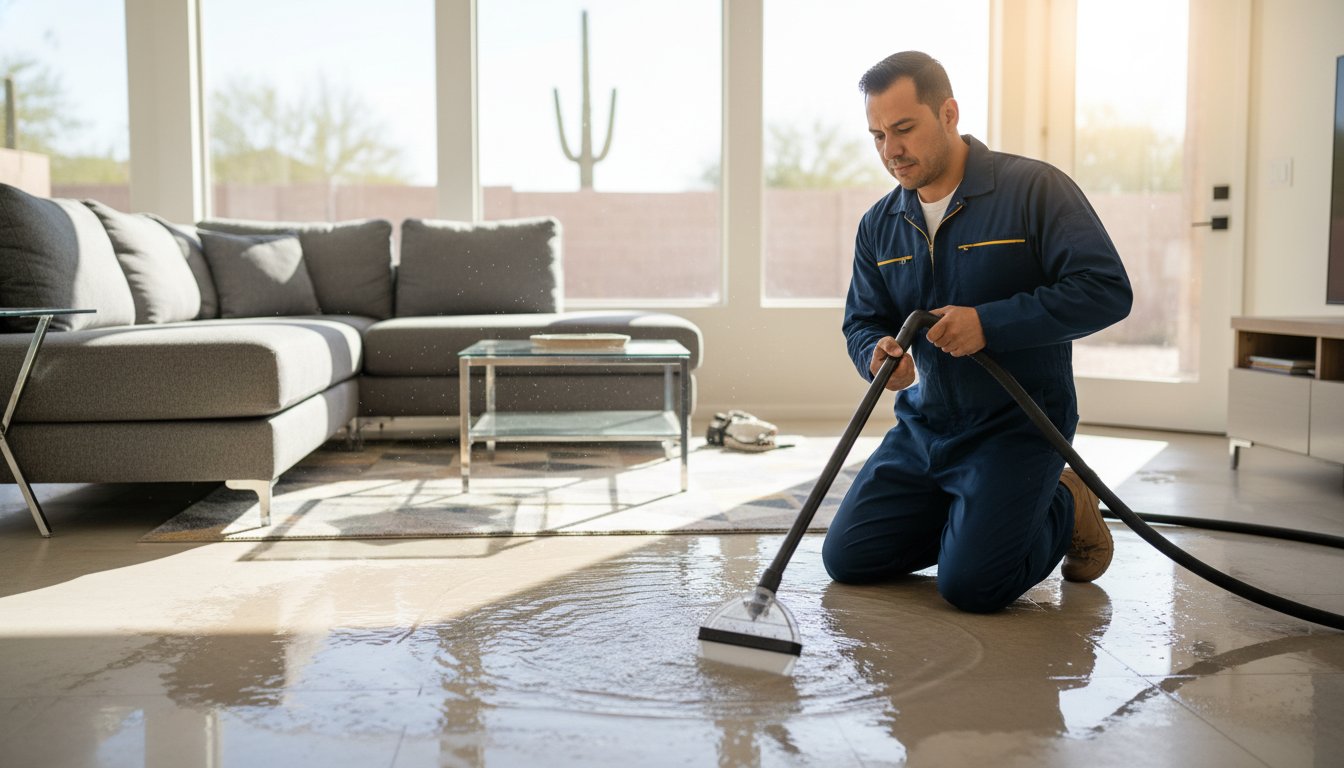
The first 90 minutes after a basement flood determine whether your property can be saved or if it becomes a breeding ground for toxic mold. Seeing your flooring soaked and your drywall crumbling is a nightmare no homeowner in Mesa or Phoenix wants to face. You’re likely searching for flooded basement cleanup near me because the water is rising and the panic is setting in. It’s completely normal to feel overwhelmed by the sudden mess and the looming threat of complex insurance paperwork.
You don’t have to handle this chaos alone. This guide provides a clear path to get your basement dry, safe, and fully restored using a professional 90-minute emergency response strategy. We’ll walk you through the critical steps of professional extraction, how to navigate Arizona’s two-year statute of limitations for property damage, and the best ways to ensure your claim doesn’t stall your recovery. From monsoon flash floods to aging plumbing leaks, you’ll learn exactly how to bring tranquility back to your home.
Key Takeaways
- Act within the 90-minute window to stabilize your property and prevent permanent structural damage or toxic mold growth.
- Discover why industrial-grade extraction and the science of psychrometry are necessary to remove deep-seated moisture that household vacuums miss.
- Navigate the search for flooded basement cleanup near me by identifying how Arizona’s “Caliche” soil and monsoon cycles create specific restoration challenges.
- Learn how to distinguish between flood insurance and water backup endorsements to protect your financial interests during an adjuster walkthrough.
- Ensure long-term peace of mind by choosing a local partner that provides a two-year warranty on full-service reconstruction and restoration.
What to Do Immediately: Your 90-Minute Emergency Response Plan
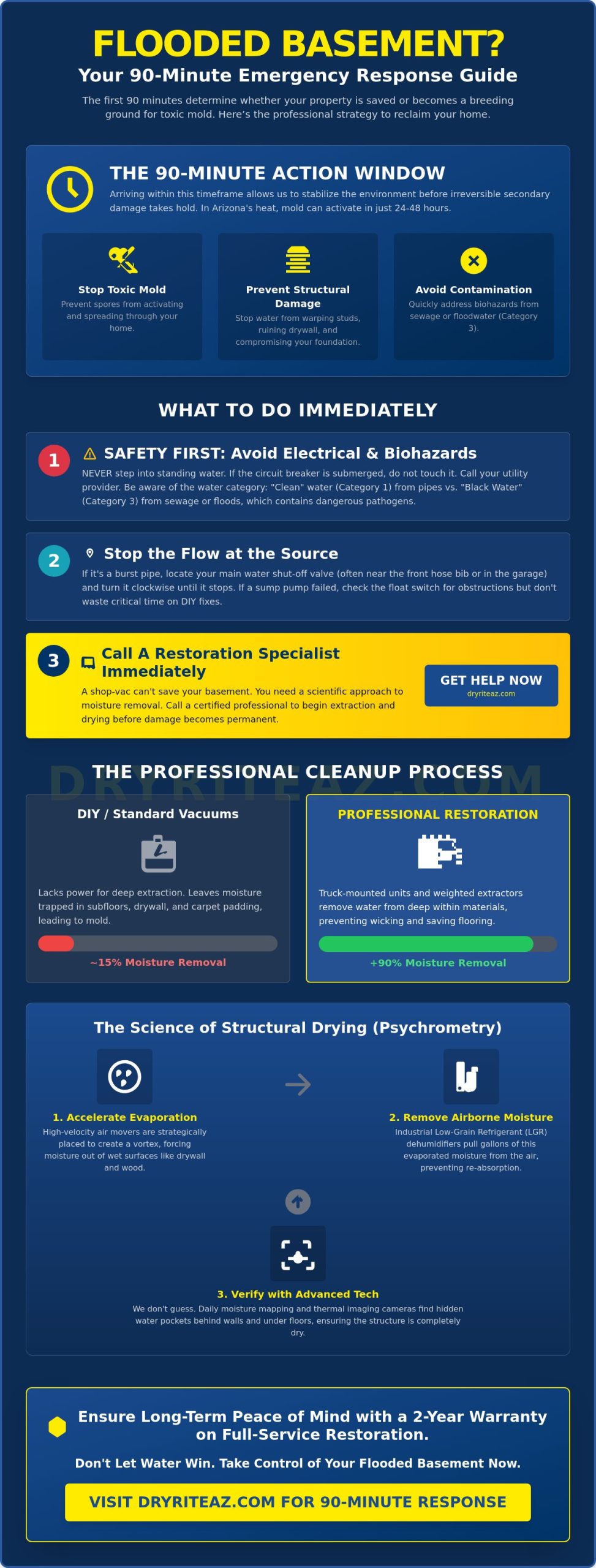
Seconds count when your basement is underwater. You’re likely searching for flooded basement cleanup near me because every minute the water sits, it migrates deeper into your foundation and wall studs. We follow a strict 90-minute rule. Arriving within this window allows us to stabilize the environment before secondary damage, like structural warping or microbial growth, takes hold. Arizona’s heat accelerates mold, so immediate action isn’t just a suggestion; it’s a necessity for your home’s survival.
Safety First: Electricity and Biohazards
Never step into standing water. If your circuit breaker is in the basement and currently submerged, don’t touch it. Call your utility provider to pull the meter from the outside if you can’t safely access the panel. Beyond the shock risk, you must assess the water’s category. Category 1 is “clean” water from a supply line. Category 3, or “black water,” contains sewage or silt from a monsoon flash flood. These pathogens require professional-grade sanitization. A foundational part of understanding water damage involves recognizing that what looks clear might already be contaminated by floor chemicals or bacteria. If you must enter the area briefly, wear rubber boots and heavy gloves. Don’t risk skin contact with unknown contaminants.
Stop the Flow: Locating the Source
Find the leak and kill the supply. If a pipe burst, turn your main water shut-off valve clockwise until it stops. Most Arizona homes have this valve near the front hose bib or in the garage. If the water is coming from a failed sump pump during a storm, check the float switch for obstructions, but don’t spend more than a few minutes on DIY fixes. Securing professional flooded basement cleanup near me ensures that the source is neutralized and the restoration begins before mold spores activate. For active plumbing failures, you’ll need an emergency plumber to stop the leak. However, for the extraction and drying of the structure, a restoration specialist is your primary partner. We focus on the environment, ensuring the moisture is removed before it ruins your drywall and flooring permanently.
The Professional Cleanup Process: From Extraction to Structural Drying
A standard shop-vac cannot save your basement. It lacks the vacuum lift and tank capacity to handle thousands of gallons of standing water before that moisture migrates into your foundation and structural framing. When you search for flooded basement cleanup near me, you need more than just a pump; you need a scientific approach to moisture removal. Professional restoration relies on psychrometry. This is the study of air, temperature, and water vapor. We use this science to manipulate your basement’s environment, forcing moisture out of dense materials like studs and subfloors. We follow the IICRC S500 professional restoration standards to ensure every step of our process is documented and effective.
Industrial Water Extraction and Pumping
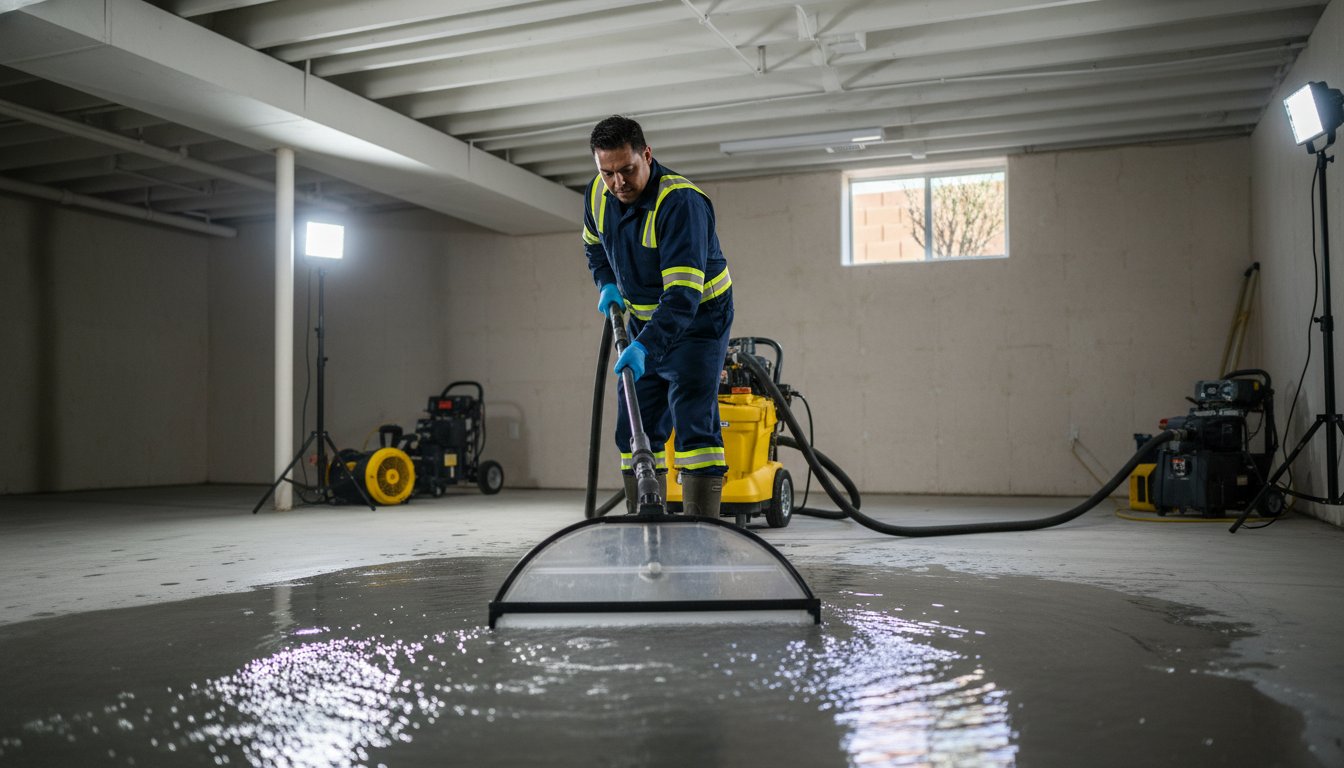
Our response teams arrive with truck-mounted extraction units that provide massive suction power. For deep flooding scenarios, we deploy submersible pumps to clear high volumes of water rapidly. This speed is critical to prevent the “wicking” effect, where water climbs up your drywall like a sponge. We don’t just stop at the surface. We use specialized weighted extractors on carpets and pads. These tools use the technician’s weight to squeeze water out of the deepest fibers, often allowing us to save expensive flooring that would otherwise be destined for a landfill. This aggressive extraction phase removes 90 percent of the moisture, making the subsequent drying phase much faster and more reliable.
Advanced Structural Drying and Dehumidification
Once the standing water is gone, we address the humidity. High-velocity air movers are positioned strategically to create a constant flow of air across wet surfaces. This accelerates evaporation. To manage the resulting moisture in the air, we use Low-grain refrigerant (LGR) dehumidifiers. These industrial-grade machines are far more powerful than residential units; they can pull gallons of water from the air even in the arid Arizona climate. We don’t guess when the job is done. Our technicians perform daily moisture mapping to document the progress of the drying cycle. We also utilize thermal imaging leak detection to find hidden pockets of water trapped behind finished walls or under cabinets. This ensures no moisture is left behind to fuel future mold colonies. If you are currently facing a water crisis, reaching out for expert water damage restoration is the most effective way to protect your investment and your health.
Finally, we apply hospital-grade antimicrobial treatments to all affected surfaces. This step is non-negotiable, especially in basements where airflow is naturally limited. These treatments sanitize the area and create a protective barrier against fungal growth. By combining rapid extraction, controlled drying, and advanced sanitization, we transform a chaotic disaster into a stable, dry environment ready for reconstruction.
Navigating Insurance Claims for Basement Flooding in Arizona
Insurance paperwork is often more stressful than the water itself. In Arizona, standard homeowners’ policies usually don’t cover monsoon-driven surface water unless you have a separate flood insurance policy. However, many basement incidents are covered under “water backup” endorsements if a sump pump fails or a drain overflows. You need to know which coverage applies before the adjuster arrives. When you call for flooded basement cleanup near me, we don’t just pump water. We act as your professional advocate. We’re on-site during the adjuster walkthrough to ensure every hidden pocket of moisture is accounted for and included in your claim. This prevents you from being left with unpaid structural repairs later.
Documentation: The Key to a Successful Claim
Clear evidence is your best defense against a denied claim. Start by capturing high-resolution “before” photos and videos of the damage and the source. Don’t throw anything away yet. Create a comprehensive inventory of damaged basement contents, including electronics, stored furniture, and personal items. Carriers require more than just photos; they demand technical proof. We provide detailed moisture logs and thermal imaging reports that prove the extent of the saturation. These professional readings are essential because they provide a scientific baseline for the drying process. Most carriers won’t approve structural drying costs without this specific data to justify the equipment usage.
Direct Insurance Billing: Eliminating Administrative Friction
We aim to lower your stress by handling the financial logistics directly with your carrier. Our team uses Xactimate software. This is the same estimating platform used by nearly every major insurance company in the country. By using industry-standard pricing, we eliminate the back-and-forth arguments over labor rates and material costs. We submit claims directly to major Arizona carriers, which means you aren’t stuck playing messenger between the restoration team and the adjuster. This direct communication ensures that your flooded basement cleanup near me proceeds without administrative delays. We manage the documentation so you can focus on getting your home back to normal. Our goal is to bring order to the chaos by making the recovery process as seamless as possible for your family.
Identifying the Cause: Why Arizona Basements Flood
Arizona’s climate is a paradox of extreme drought and sudden, violent saturation. When you search for flooded basement cleanup near me, the cause is often rooted in the unique geology of the Sonoran Desert. Unlike the porous soil found in the Midwest, much of Mesa and Phoenix sits on a layer of “Caliche.” This is a natural, cement like hard-pan soil that refuses to absorb water. During a heavy downpour, rain doesn’t soak into the ground; it pools on the surface and exerts massive hydrostatic pressure against your basement walls. This pressure eventually finds any hairline crack in your foundation, turning a small seep into a full scale flood in minutes.
Monsoon Storms and Flash Flooding
The Arizona monsoon season, running from June through September, is the primary driver of residential water damage. These storms dump months’ worth of rain in under an hour, easily overwhelming municipal drainage systems. In neighborhoods across Mesa and Gilbert, rapid runoff often enters homes through basement window wells or low-lying vents. Proper yard grading is your first line of defense. If your soil slopes toward your foundation rather than away from it, you’re essentially inviting the next flash flood into your living space. We recommend clearing your gutters and checking your window well drains every May to prepare for the summer storm cycle.
Sump Pump Maintenance and Failure
Mechanical failure is the leading “silent” cause of basement flooding in the Valley. Most basements here rely on a sump pump to combat the Caliche pooling mentioned earlier. However, these pumps often fail during the exact moment they are needed most. Power outages during monsoon thunderstorms will kill a standard pump unless it has a dedicated battery backup. We frequently see floods caused by stuck float switches or clogged intake screens. Test your pump by pouring a five-gallon bucket of water into the pit to ensure it triggers. If your system is over seven years old, it’s likely approaching the end of its reliable lifespan. Don’t wait for a storm to realize your equipment is dead.
Internal plumbing catastrophes also play a major role, especially in homes built before 1970. Aging infrastructure is prone to mineral buildup and pipe corrosion. A burst water heater or a failed supply line can dump hundreds of gallons into your basement before you even notice a drop in pressure. Because these incidents often involve “clean” water initially, they are the best candidates for successful restoration if caught early. If you’ve discovered standing water from a mechanical break, contact us for immediate water damage restoration to save your flooring and drywall. Understanding these local risks helps you move from a state of panic to a state of informed action.
Choosing Dryrite Restoration for Full-Service Basement Recovery
Selecting the right partner for flooded basement cleanup near me involves more than just finding a technician with a pump. You need a team that acts as a stabilizing force during a crisis. Since 2004, Dryrite Restoration has served as a seasoned expert for homeowners across the Phoenix Metro area. We are licensed, insured, and IICRC certified. This ensures that every phase of your recovery follows the highest industry standards for safety and efficacy. Our commitment to your long-term security is anchored by the Dryrite 2-year warranty. We don’t just fix the immediate problem; we stand by the quality of our work long after the equipment is gone. This focus on emotional and physical well-being is what distinguishes a trusted specialist from a standard service provider.
Beyond Drying: Complete Reconstruction Services
Drying out the structure is only the first half of the battle. Many companies leave you with a dry but demolished basement, forcing you to manage the stress of finding a separate contractor to finish the job. We believe in a seamless recovery. We provide full-service reconstruction services to return your home to its pre-loss condition. Our team manages the entire project internally, from replacing saturated drywall to installing new flooring and baseboards. This internal accountability ensures there are no communication gaps or delays. We protect your interests by handling the project from start to finish, providing a single point of contact for both the cleanup and the rebuild.
The Dryrite Difference: 90-Minute Arrival
Speed is the ultimate trust signal in emergency restoration. We understand that water migration never stops, which is why we’ve committed to a 90-minute arrival time for our neighbors in Mesa, Tempe, and Scottsdale. This rapid response is the only way to prevent permanent structural loss and the onset of mold in Arizona’s climate. As a family-owned business, we offer a level of personal care and accountability that national franchises often lack. We aren’t just a service provider; we are your local experts who understand the specific challenges of Arizona basement flooding. We bring order to chaos and tranquility back to your home. Restore your peace of mind today by letting our experienced protectors handle your flooded basement cleanup near me with the urgency it deserves.
Take Control of Your Basement Recovery Now
A flooded basement is a crisis, but it doesn’t have to be a permanent disaster. By acting within the critical 90-minute window, you effectively halt the progression of structural decay and mold growth. You now understand that professional extraction and scientific drying are the only ways to ensure your foundation stays sound. Navigating insurance claims becomes a much simpler process when you have an advocate who uses industry-standard software and provides direct billing to minimize your out-of-pocket stress.
Choosing the right partner for flooded basement cleanup near me means prioritizing speed, expertise, and long-term protection. We provide a 90-minute emergency response and a 2-year warranty on mitigation to ensure your home remains a safe haven. Don’t let standing water dictate your home’s future. Call Dryrite Restoration Now for 24/7 Emergency Basement Cleanup and let us handle the heavy lifting. You can move past this chaos. We’re ready to help you bring tranquility back to your property today.
Frequently Asked Questions
How much does flooded basement cleanup cost in Mesa?
The cost of restoration depends on the volume of water and the level of contamination. Factors like the size of the affected area and the type of materials, such as drywall versus concrete, influence the final price. Professional cleanup involves extraction, industrial drying, and sanitization. You should request a detailed estimate that follows industry standards to understand the specific requirements for your property’s recovery.
Will my homeowners insurance cover a flooded basement?
Coverage depends entirely on the source of the water. Standard policies typically cover sudden pipe bursts or appliance malfunctions. However, damage from monsoon surface water often requires a separate flood insurance policy. Sump pump failures or sewer backups usually require a specific endorsement. We recommend reviewing your declarations page to confirm your specific coverage limits and deductibles before a storm hits.
How long does it take to dry out a basement after a flood?
Most basements take between three and five days to dry completely. This timeline varies based on the materials involved and the relative humidity levels. Dense materials like structural studs and subfloors take longer to release moisture than surface drywall. We use daily moisture mapping to track this progress. This ensures the environment is stable before we begin any reconstruction or final repairs.
Can I clean up a flooded basement myself?
Attempting a DIY cleanup is dangerous due to electrical hazards and hidden biohazards. Household vacuums lack the lift needed to remove water from deep within the foundation or wall cavities. Searching for flooded basement cleanup near me ensures you have the industrial equipment required to prevent permanent structural rot. Professionals also use thermal imaging to find moisture that is invisible to the naked eye.
What is the “90-minute rule” for water damage?
The 90-minute rule is our commitment to arriving on-site within an hour and a half of your call. This window is critical because it allows us to stabilize the environment before mold spores activate or drywall begins to lose its integrity. Rapid intervention significantly reduces the total cost of the claim. It also increases the chances of saving expensive materials like flooring and cabinetry.
Is mold guaranteed to grow after a basement flood?
Mold is not a guarantee if you address the moisture immediately. Fungal colonies typically begin to form within 24 to 48 hours of initial exposure. If the area is professionally dried and treated with antimicrobial agents within this timeframe, the risk is minimal. However, leaving moisture trapped behind baseboards or under flooring will almost certainly lead to a mold infestation in the Arizona heat.
What is the difference between a flood claim and a water backup claim?
A flood claim involves external water rising from the ground, such as monsoon runoff or flash flooding. A water backup claim covers water that enters through a drain, sewer line, or failed sump pump. These require different insurance coverages. Most standard Arizona policies exclude rising ground water unless you have a specific policy through the National Flood Insurance Program (NFIP).
Do I need to replace my basement carpet after it floods?
Carpet replacement depends on the category of the water. If the flood came from a clean pipe burst, we can often save the carpet through aggressive extraction and sanitization. If the water is Category 3, such as sewage or outdoor silt, the carpet and pad must be replaced for safety. We use professional flooded basement cleanup near me protocols to determine if your flooring is salvageable or a health risk.